
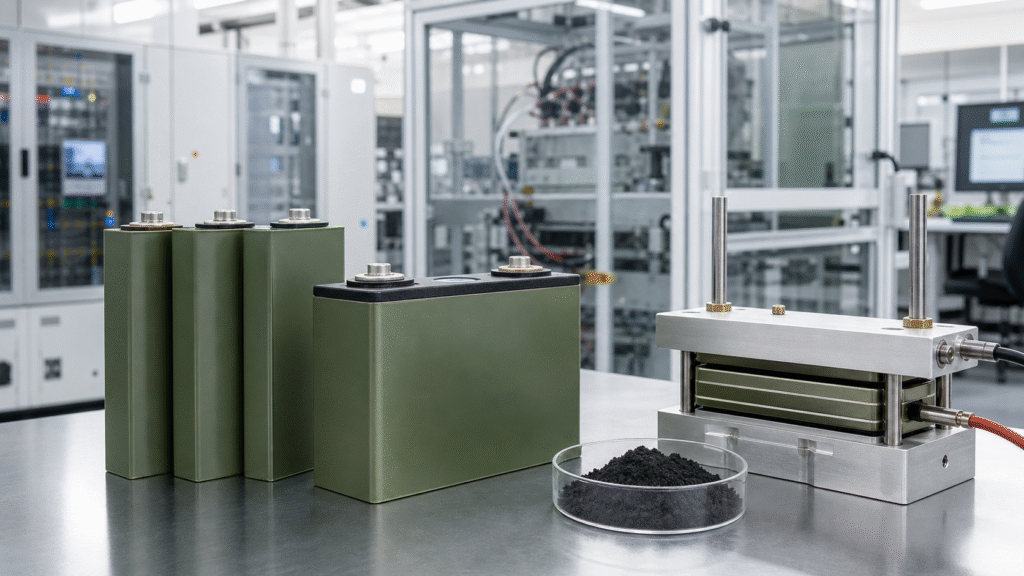

Lithium iron phosphate prismatic cells and LFP cathode powder in a battery laboratory
Lithium iron phosphate, commonly abbreviated as LFP, is a lithium-ion cathode material valued for thermal stability, long cycle life, and the absence of nickel and cobalt in its active chemistry. It is widely used in energy-storage systems, electric mobility, industrial equipment, backup power, and other applications where safety and durability are more important than maximum energy density.
Why Lithium Iron Phosphate Is Popular
The olivine crystal structure of LFP provides strong chemical and thermal stability. This characteristic supports a stable operating profile and makes LFP attractive for large battery systems. LFP cells also commonly deliver long cycle life when they are operated within appropriate voltage, current, and temperature limits.
Another advantage is raw-material availability. Iron and phosphate are relatively abundant, helping reduce exposure to nickel and cobalt supply risks. LFP also has a comparatively flat discharge-voltage curve, which can be useful for delivering consistent power but requires accurate state-of-charge estimation.
Limitations to Consider
LFP generally has lower gravimetric and volumetric energy density than high-nickel cathode chemistries. Its electronic and ionic conductivity also require careful particle engineering and conductive-network design. Low-temperature charging must be controlled because the anode, electrolyte, and full-cell design can still present lithium-plating risks.
These limitations do not make LFP unsuitable; they simply mean that material grade, electrode design, cell format, and operating strategy must match the application.
LFP Electrode Manufacturing
An LFP cathode formulation normally includes active powder, conductive additives, binder, and solvent or water, depending on the selected process. Important factors include powder moisture, dispersion, slurry viscosity, coating weight, drying profile, electrode adhesion, calendered density, and porosity.
For meaningful comparison, researchers should control electrode loading and density rather than comparing materials only at different coating conditions. Incoming material data such as particle size, tap density, carbon coating, and moisture content should be recorded for each batch.
Common LFP Applications
LFP is frequently used in stationary energy storage, commercial vehicles, entry-level and standard-range electric vehicles, forklifts, marine systems, telecommunications backup, solar storage, and industrial battery packs. Large prismatic cells are common in storage and mobility, while cylindrical LFP formats are used where mechanical modularity is valuable.
Testing LFP Cells
Evaluation should include capacity, rate capability, DC resistance, energy efficiency, cycle life, temperature performance, storage behavior, and safety limits. A suitable battery cycler, temperature chamber, fixtures, and calibrated sensors are required for repeatable data.
Solisn supplies LFP materials, prismatic and cylindrical cells, battery cyclers, electrode equipment, and cell-assembly hardware. Contact us to discuss your LFP research or sourcing requirements.