
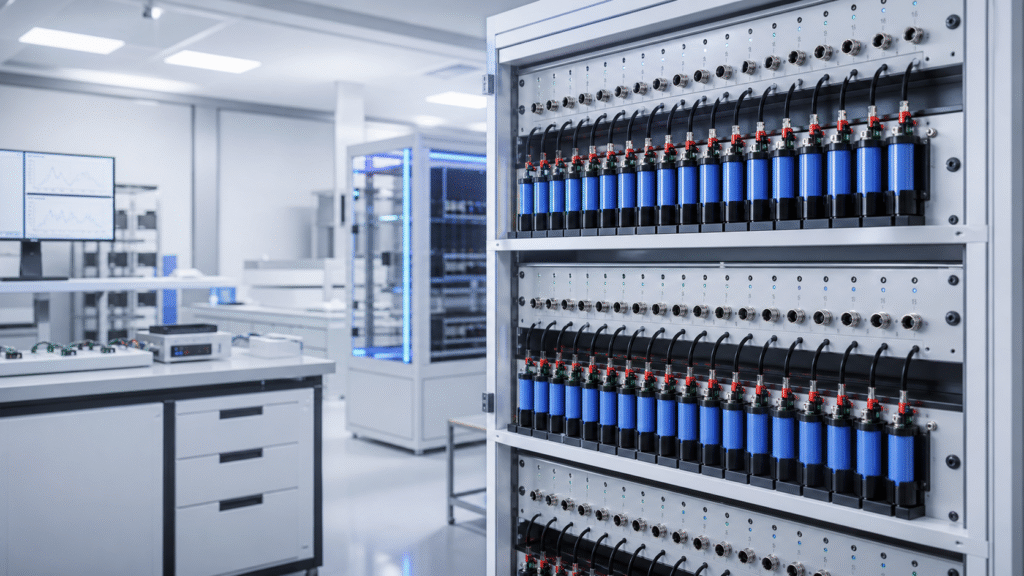

Multi-channel battery cycler testing cylindrical lithium cells in a laboratory
A battery cycler is one of the most important instruments in cell research, quality control, and battery production. It repeatedly charges and discharges a cell according to a programmed test profile while recording voltage, current, capacity, energy, efficiency, and cycle-life data. Choosing the correct system helps a laboratory generate reliable results and prevents expensive equipment from becoming a testing bottleneck.
What Does a Battery Cycler Measure?
A modern battery cycler can perform constant-current charging, constant-voltage charging, constant-power operation, pulse testing, capacity measurement, and long-term cycling. Depending on the software, it may also calculate coulombic efficiency, energy efficiency, DC internal resistance, and capacity retention.
These functions are useful for comparing lithium battery materials, evaluating finished cells, validating formation procedures, and studying degradation under different temperatures and C-rates.
Key Specifications to Compare
Start with the voltage and current range. Coin cells and small cylindrical cells may require high accuracy at low current, while large prismatic cells need higher-current channels and heavier fixtures. The selected current range should cover both normal cycling and the pulse conditions required by the test plan.
Accuracy and resolution are equally important. A high channel count is attractive, but channel-to-channel consistency, calibration support, data sampling rate, and long-term stability often matter more than the headline number of channels.
Also evaluate:
- Independent or parallel channel operation
- Charge and discharge power limits
- Current rise time and data acquisition speed
- Temperature chamber integration
- Cell holders and four-wire connections
- Software export formats and remote monitoring
- Safety functions for overvoltage, overcurrent, and overheating
Matching the Cycler to the Cell Format
Testing an 18650 or 21700 cell requires reliable cylindrical fixtures and adequate heat spacing. Prismatic cells such as high-capacity LFP cells need low-resistance busbars, secure terminals, and careful temperature monitoring. Coin-cell research often benefits from microamp-level resolution because early material screening may use very low current.
Final Selection Advice
The best battery cycler is not simply the system with the highest current or the most channels. It is the platform that matches the cell format, test protocol, accuracy target, laboratory throughput, and future expansion plan. Before purchasing, prepare a list of cell types, voltage windows, maximum currents, test duration, and required data outputs.
Solisn can help laboratories source battery cyclers, fixtures, cell materials, and supporting equipment for complete battery R&D workflows. Contact our team with your test requirements for a suitable configuration.